Posts

Showing posts with the label Dynamic Random Access Memory

Internal Memory

Internal Memory  is the memory device that often use by Central Processing Unit (CPU) for the fast performance.However,the faster the performance the higher the cost of memory per bit. Internal Memory is volatile except the ROM. Cost per bit compare to external Memory is more expensive. Function of Internal memory is to  Temporarily store data and instructions that are being executed or will be executed by the CPU. Internal Memory can divided into 3 types: Register Cache Main Memory Register   located inside the processor. Each register typically holds a word of data (often 32 or 64 bits). Fastest of all forms of computer data storage but also most expensive. Cache Processor cache is an intermediate stage between ultra-fast registers and much slower main memory. It's introduced solely to increase performance of the computer. Most actively used information in the main memory is just duplicated in the cache memory, which is fas...
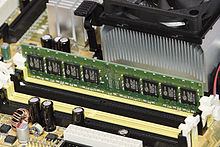
Random Access memory (RAM)

Image
Because of the demands made by increasingly powerful operating systems and software, system RAM requirements have accelerated dramatically over time.  For instance, at the turn of the millennium a typical computer may have only 128Mb of RAM in total, but in 2007 computers commonly ship with 2Gb of RAM installed, and may include graphics cards with their own additional 512Mb of RAM and more. RAM Changes constantly as the system Operates Providing temporary storage for all data required by the Operating System (OS) and software Directly Accessible viewed as a collection of memory location in which program instructions and data are stored Each memory location is referenced by a unique address assigned to it.  The main memory of the computer is faster than external memory. The contents of each memory location are directly accessed using the address of location. Reading and writing of data is done electronically without any mechanical movement.  Volatil...

Reading & Writing Operation of DRAM

Image
In Dynamic Random Access Memory CELL , transistor acts as a switch to Close (allowing current to flow) when voltage applied in address line or Open (no current flow) when no voltage applied in address line.Address Line also known as word line .Which use to signal the transistor to close or open. During the Write operation ,a voltage is applied on the bit line and a signal applied to the address line to close the transistor.Then the voltage applied on the bit line will transfer to capacitor and store in the capacitor However the capacitor has tendency to discharge and has to refresh to maintain the bit. While in Reading Operation ,the instruction find the bit store using the address line to read the data or bit. When the address line is selected ,the transistor turns on and the charge stored on the capacitor is fled out onto a bit line and to sense amplifier. Sense amplifiers compare the capacitor voltage to reference value to determine the logic 1 or logic 0.The read out from ...